Arthur Leander
Station ElevenArthur Leander is a stage and film actor whose death during a performance of King Lear connects the novel’s pre-collapse lives to its devastated future. At the Elgin Theatre in Toronto, he falters beneath the stage lights while playing Lear; in the years after the Georgia Flu, his image and work persist in the Travelling Symphony’s performances, a newspaper account of Kirsten Raymonde, and a comic that Clark Thompson recognizes as an echo of his own past. His life is not presented as a settled biography so much as a series of surviving fragments: public acclaim, failed marriages, a son living far away, and memories that return at the moment his body gives way.
Identity and Public Life
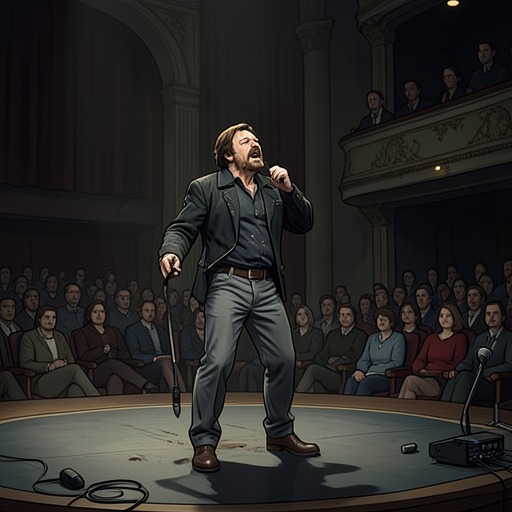
Arthur is fifty-one when he collapses onstage. In the opening performance, he stands in a pool of blue light in act four of King Lear, wearing flowers in his hair. Earlier, three girls have played a clapping game as the audience entered; now, in Lear’s mad scene, they return as hallucinated versions of his daughters. Arthur reaches toward them as they move through the shadows, and the stage’s theatrical unreality becomes inseparable from his physical crisis.
His public career encompasses both film and theatre. At thirty-six, he has been filming a period drama in Toronto, working partly on a soundstage and partly in a park outside the city. A decade and a half later, his obituary describes him as a film and stage actor, but reduces his life to a sequence of failed marriages and the separation from his son. The contrast is sharp: the obituary can name the career and list the marriages, yet cannot identify the audience member who tried to save him when he collapsed.
Marriage, Family, and Distance
Arthur’s relationships are marked by separation and attempted return. At a Toronto restaurant, he waits by the coat check with Miranda Carroll, who has a recent bruise on her face and tells him in a whisper that she is going to leave someone. Arthur is thirty-six, wearing a Toronto Blue Jays cap after a week in costume for a period film. The scene places their private conversation among the ordinary precautions of a public room, staff nearby and the two speaking quietly to avoid being overheard.
His later marriages appear in the fragments of a public record. Clark learns that Arthur’s third wife, Lydia Marks, has recently served him with divorce papers; Elizabeth Colton, the wife before Lydia, has taken their son Tyler to Jerusalem. When Arthur tells Clark that he is going to Paris to visit Tyler, who is vacationing there with Elizabeth, he calls it a difficult year. His distress is not simply about the end of a marriage: he is trying to understand why his son is so far away, and why that distance has become part of family life.
A tabloid photograph supplies a more intimate image of father and son. Arthur, unshaven and rumpled beneath a baseball cap, carries seven-year-old Tyler, who beams up at him while Arthur smiles for the camera. The report says Tyler lives in Jerusalem with Elizabeth. Kirsten later finds the photograph in a discarded magazine and recognizes Arthur as the actor who gave her comics. The Georgia Flu will arrive a year after the photograph, turning a piece of celebrity news into a remnant of the world that is about to disappear.
On his last morning, Arthur has decided that when King Lear closes he will move to Israel. He imagines shedding his obligations and belongings, buying an apartment within walking distance of Elizabeth’s home, and seeing Tyler every day. The plan gives his final day a forward direction: he expects a new beginning after the production ends. The coming performance, instead, becomes the end of the life he hoped to reorganize around his son.
Childhood Memories and the Final Performance
The account of Arthur’s last morning is made from modest routines. After three nights of insomnia, he wakes exhausted and dehydrated, irritated to find only a mouthful of orange juice left. He checks his anger by breathing deeply and counting to five, eats scrambled eggs, showers, dresses, and leaves early enough to linger over a newspaper and a second-to-last coffee at his favourite café. These ordinary details give the day the shape of a life still in progress, even as a snowstorm approaches and he carries the decision to move to Israel.
During the performance, Arthur loses his place and delivers a line that does not belong where he speaks it: “Down from the waist they are Centaurs.” He reaches for a plywood pillar but misjudges the distance, striking it with his hand, then cradles that hand against his chest. The audience is initially unsure whether he is acting. Jeevan Chaudhary, seated in the first row and trained as a paramedic, rises to help, even as his girlfriend and other people in the theatre urge him to sit down. Arthur whispers, “The wren goes to’t,” and Jeevan recognizes that he has skipped back twelve lines.
The familiar movement of Arthur’s hand opens onto an earlier memory. When he was seven, on Delano Island, he and his brother found a wounded bird on the beach. The bird’s heart stopped in Arthur’s palm as he held it. In the theatre, he makes the same gesture while his own heart fails. His memories widen further: he hears the waves from the beach and recalls seeing Comet Hyakutake as a teenager outside his friend Victoria’s house. The stage seems to hold more than one place at once, while falling snow catches the lights around him. Arthur thinks it is the most beautiful thing he has ever seen.
Afterlife in Performance and Memory
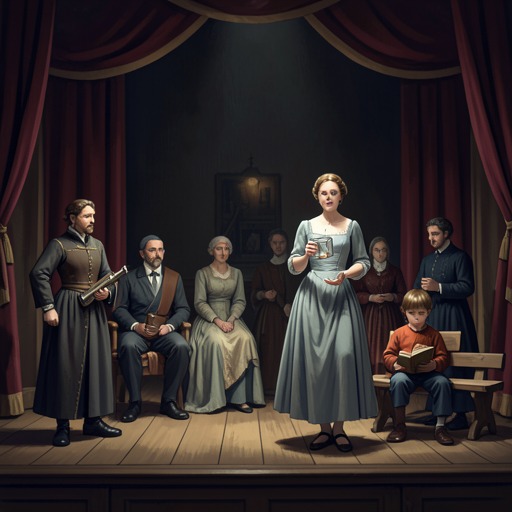
Arthur’s story continues through art that outlasts the society in which he made his career. In St. Deborah by the Water, the Travelling Symphony performs A Midsummer Night’s Dream in a parking lot near Lake Michigan. Kirsten Raymonde plays Titania in candlelight, wearing a flower crown and a scavenged wedding dress streaked with blue watercolour. Her lines about contagious fogs and altered seasons resonate in a world where plague has already remade the conditions of life. The performance does not preserve Arthur personally, but it shows how theatre carries old language into circumstances its first audiences could not have known.
The Symphony’s caravans carry the words “Because survival is insufficient.” That principle distinguishes mere continuation from the work of keeping stories, music, and performance alive. Years later, a New Petoskey newspaper reports on the Symphony’s visit and praises a King Lear performance, naming Gil Harris as Lear and Kirsten as Cordelia. The play associated with Arthur’s death has entered a new community’s local record, performed by different actors and read through the experience of a changed world.
At Severn City Airport, Clark reads Arthur’s obituary in a discarded New York Times and folds the paper into his suitcase. The obituary gives him a compressed account of Arthur’s marriages and death, while leaving the rescuer unnamed. Much later, after the Symphony has stayed at the airport for five weeks, Kirsten gives Clark one of her two Dr. Eleven comics so that one copy will remain safe as the troupe travels into unfamiliar territory. Reading it by candlelight, Clark recognizes a comic-book dinner party as an altered version of a gathering in Los Angeles before the collapse. Elizabeth is present in both; a figure resembling Arthur appears in the shadows, while Dr. Eleven occupies the place of Miranda Carroll. Clark remembers the guests, the caterers, and Arthur behaving disgracefully, and feels affection for them all. Arthur survives here not as a complete or idealized portrait, but as one of the imperfect people Clark remembers among the vanished lights of the old world.